Transmigration of childhood into the virtual world
The first installment of a creative discourse retrospective exploring the friction between our HDB childhoods, the heavy pull of modern screen habits, and the omniscient intervention.
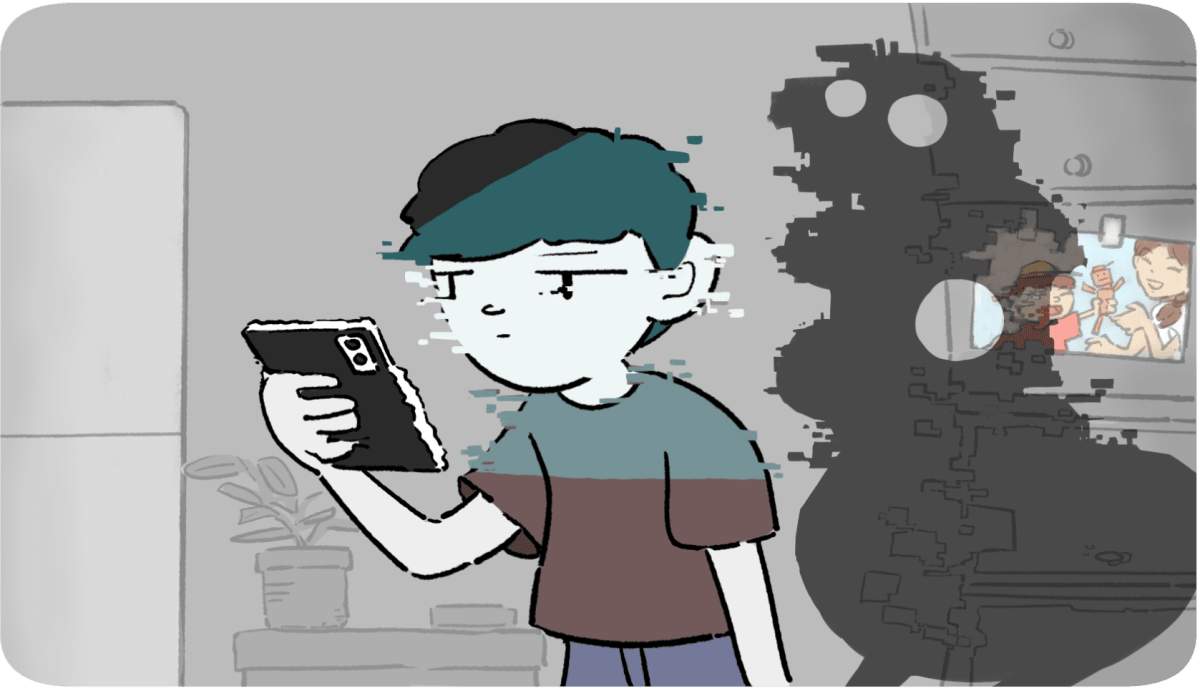

There was a time when our greatest adventures lived not in digital screens, but in a wonderfully three-dimensional world. Not too many years ago, children did not stare blankly into glowing bricks to entertain themselves. Instead . . .

The warm, tropical breeze sweeping through these open-air walkways, carrying the comforting scents of simmering curries and frying garlic wafting from the kitchens. These communal areas were extensions of our homes and the living embodiment of the kampung spirit.

, void decks transformed into soccer pitches, and slippers into goalposts. The rhythmic thud of a ball amidst raucous laughter would sound; endearing and irritating in equal measure. Nearby, ordinary stairwells would turn into tactical routes for children scurrying between floors during intense games of block catching, desperately trying to juke the catcher.
We would play on, utterly oblivious to the passage of time, until the distant, ringing cry of their mothers calling them for dinner . . .

This creative discourse attempts to peer behind the digital veil, examining how contemporary online habits, social connections, and tangible, real-world interactions come together to form the complex tapestry of modern youth development.
As a computer science student myself, I get to see lines of code compiled into the real-life equivalent of magic; software that fundamentally changes how we navigate life. With this insider perspective, I find myself examining this shift through an entirely different lens. I am no longer just reminiscing about the physical void decks where we used to hang out; instead, I recognise that our youth now congregate in digital spaces. Through partnership initiatives like Project Void_Deck with Div0, Singapore’s premier cybersecurity community, I am actively learning the mechanics of this modern "void deck," working to understand and secure the virtual environments our youth cohabit today.
The concrete pillars and echoing stairwells of the HDB block have not vanished; rather, they have been abstracted, replaced by the invisible scaffolding of backend architectures and isolated, simulated environments. Where huddles of children once debated the rules of block catching on the fly, I now see the rigid, unyielding logic of algorithms.

The regulatory push suggests that the facade of unregulated digital spaces is finally lifting, paving the way for data-driven policies that empower lawmakers to implement evidence-based regulations.
Ultimately, these proposed regulations act much like the ringing cry of a mother calling her children home for dinner, a necessary boundary pulling society back to reality when the game has gone on for too long, or grown too reckless. As the veil lifts, we are left with a profound realisation:responsible youth development matters more than ever when navigating a landscape of manipulative, unregulated algorithms.
As future architects of this domain, my peers and I face a challenge that extends far beyond compiling efficient software. Where the physical void decks of our childhood came with occasional friction - whether literal, in the form of scraped knees, or metaphorical, in a scolding or two for causing too much noise. However, the digital 'void decks' of today eschew friction, taking away valuable learning opportunities and increasing the risk of addiction. Therefore, for the good of the next generation and beyond, we must make a deliberate effort to engineer these points back into their void deck.
Our pursuit is not to create a digital world so immersive that it replaces reality, but rather one that safely enriches it by leaving space for the next generation to still discover the joy of frolicking in the open air, and running down the corridors of the HDB block when the screens finally dim.
